Throughout the last decade, Robert completed over one hundred and fifty paintings in a limited palette ranging from white to soft gray to black, often incorporating raw canvas or linen as a compositional element of the work.

Throughout the last decade, Robert completed over one hundred and fifty paintings in a limited palette ranging from white to soft gray to black, often incorporating raw canvas or linen as a compositional element of the work.
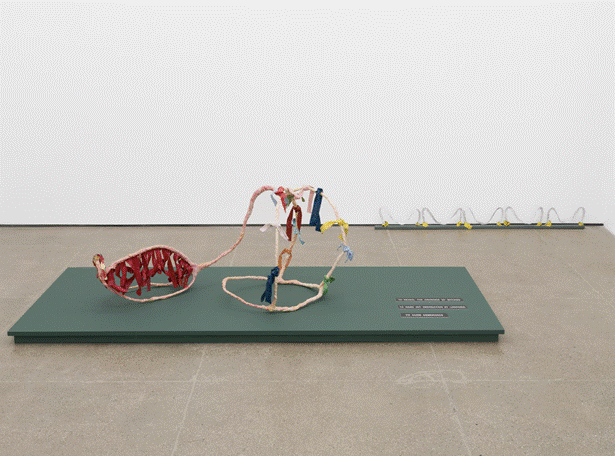
Contributed by Lila Gould / “Proserpina / Devil Chaser” at Gordon Robichaux brings together the work of Rosemary Mayer and Ree Morton for the first time, emphasizing their close friendship and uncovering the nuances, affinities and distinctions in their respective practices. At the outset, a piece from the 1975 installation Something in the Wind conveys their closeness. For this public artwork, Morton hand-sewed 100 flags and tied them on the sails of a boat docked at New York’s South Street Seaport. In an exhibition catalog, Morton explained, “I made a flag for each person in my life that I have good feelings for, or who I feel connected to in some way. It was a celebration for them and a means of identifying and locating myself in the world by naming the persons who surround me.”

Contributed by David Carrier / Brice Marden, who died in 2023, has always had an astonishing mystique. Two generations ago, when painting was often pronounced dead, he identified as a rare heroic survivor and continued to make abstractions. It was possible then to see him as the true successor to Jackson Pollock and Jasper Johns – the one artist who kept the New York School alive. But now, in a very different environment, his work has to be understood differently. Gagosian’s museum-scale retrospective “I Am Plane Image,” an exemplary exercise in curatorship, lets us appreciate at once his range and his discipline, both remarkable.
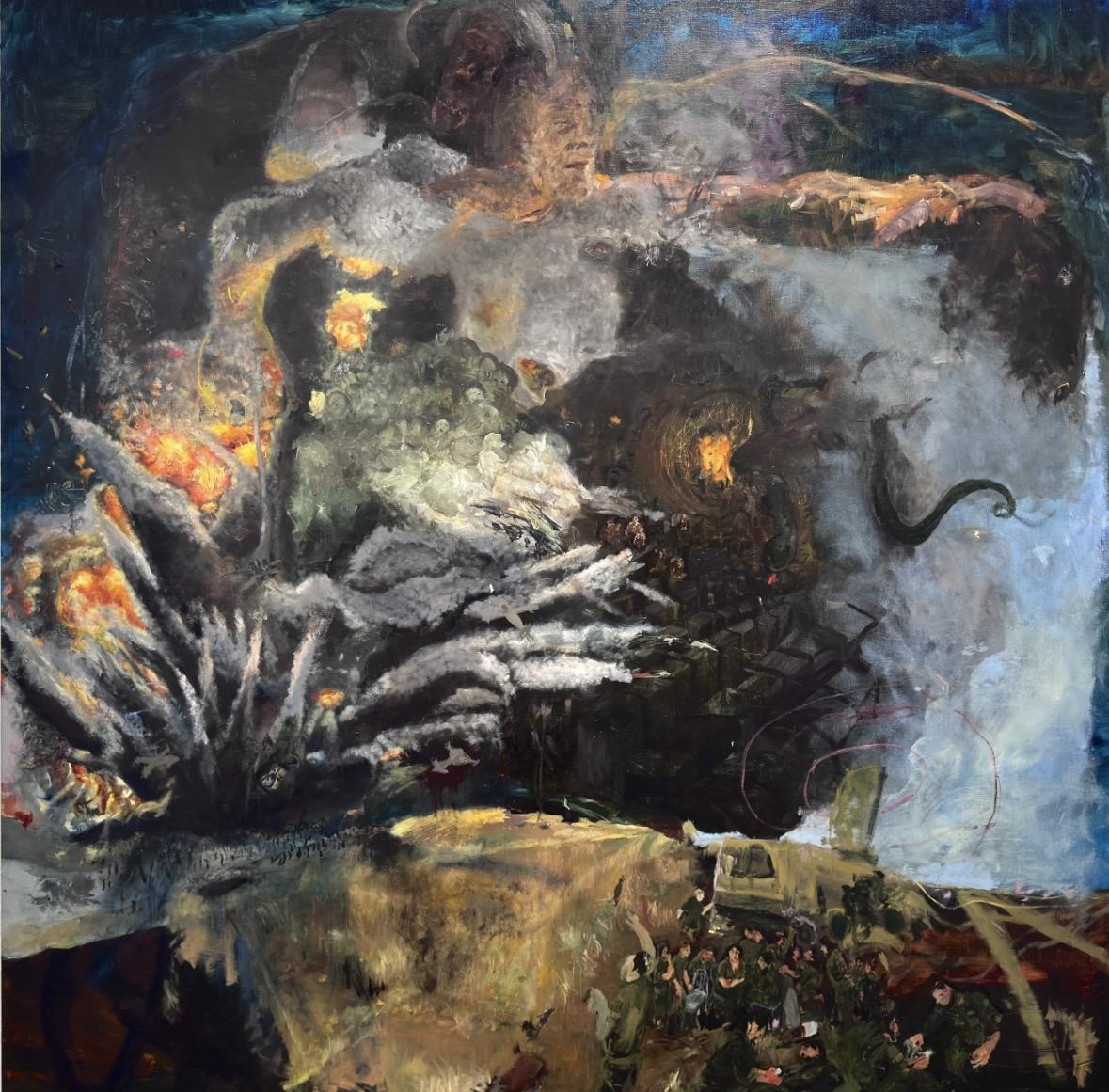
Contributed by Margaret McCann / Celeste Dupuy-Spencer (1979–2026) left too soon, but her candid, cynical expressions of Americana, angst, and injustice leave a powerful legacy. The poetically titled exhibition “Burning in the Eyes of the Maker” (Daniel Lanois lyrics) at Jeffrey Deitch Gallery has less of her colorful work. Even without the great Don’t You See That I Am Burning depicting January 6, the Trump zeitgeist is uncomfortably conjured and conjoined with (by the show’s timing and location) September 11 imagery. In the untitled painting above, nature is a wasteland through which Georg Baselitz’s itinerants, or the struggling painter, might stumble. “For me to paint,” Dupuy-Spencer admitted, “loneliness helps. Real, abject … a gaping maw.” An acrid yellow horizon yawns uneasily in the vast space. Like an unfinished painting, an inscrutable bas-relief gripped by giant hands withholds meaning from the lonely climber. White-collared, lost as the protagonist of the film Falling Down, he looks abandoned by past and future, like the exiled Dante. Disorientation replaces the faith guiding Friedrich’s wanderer, Coleridge’s optimist, Walt Whitman’s roamer.